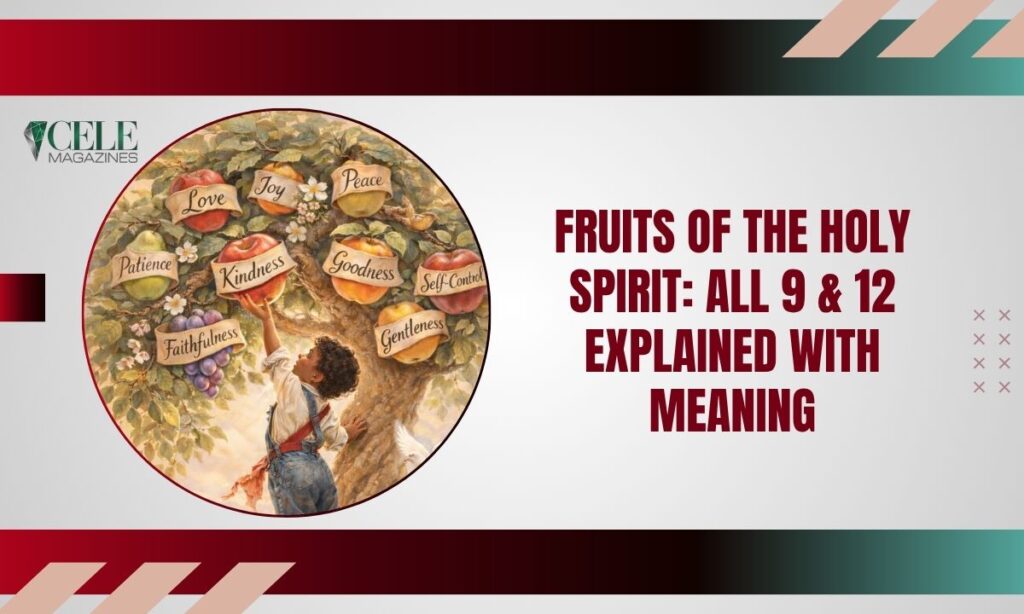
Fruits of the Holy Spirit: All 9 & 12 Explained with Meaning
May 25, 2026
By: Hayat
Most people can name a few of them. Fewer understand what they actually are, where the number 9 vs. 12 comes from, and why they matter in daily life — not just in church. This guide covers all of it: the biblical source, every fruit explained clearly, the Catholic list, the difference from gifts, and how to actually grow them.
The fruits of the Holy Spirit are virtues that grow in a believer’s life through the Holy Spirit’s active work. They’re not a checklist or a personality test. They’re evidence — visible signs that the Spirit is at work inside a person.
St. Paul introduced the term in his letter to the churches of Galatia. He contrasted the results of living by sinful nature against the results of living by the Spirit. The difference was unmistakable.
Where Does the Term Come From?
Jesus used the fruit metaphor first in Matthew 7:15–20. He said you can recognize true and false prophets by their fruit. A healthy tree produces good fruit. A diseased one produces bad fruit. St. Paul picked up that same image in Galatians 5:22–23 and applied it to the interior life.
The Greek manuscripts had no punctuation. Some theologians argue St. Paul meant love as the single fruit, with the other eight qualities describing what love looks like in practice. Whether nine separate virtues or eight expressions of love, the practical meaning doesn’t change.
The Core Bible Verse: Galatians 5:22–23
“But the fruit of the Spirit is love, joy, peace, patience, kindness, goodness, faithfulness, gentleness and self-control. Against such things there is no law.”
This verse appears in multiple translations with slight wording differences. The meaning stays consistent across all of them.
How Many Fruits of the Holy Spirit Are There?
This is one of the most searched questions on this topic, and the answer depends on your tradition.
There are two lists:
Tradition
Number
Source
Protestant / most modern Bibles
9
Greek manuscripts of Galatians 5:22–23
Catholic Church
12
St. Jerome’s Latin Vulgate translation
Both lists are rooted in Scripture. The Catholic list adds three fruits not found in shorter Greek manuscripts: longanimity (long-suffering), modesty, and chastity.
The 9 Fruits of the Holy Spirit and Their Meanings
These nine come directly from Galatians 5:22–23 and form the foundation shared across Catholic and Protestant traditions.
1. Love (Agape)
The Greek word here is agapē — selfless, sacrificial, unconditional love. It’s not a feeling. It’s a choice made regardless of what you receive in return. St. Paul described it in 1 Corinthians 13: patient, kind, not self-seeking, bearing all things. The opposite of this love is hatred, pride, and envy.
2. Joy (Chara)
Joy in Scripture is not the same as happiness. Happiness depends on circumstances. Joy is a deep, steady gladness that persists even through hardship. James 1:2 encourages believers to count it pure joy when facing trials. Nehemiah 8:10 says the joy of the Lord is your strength. The opposite is despair, negativity, and sorrow.
3. Peace (Eirēnē)
The Greek eirēnē mirrors the Hebrew shalom — not just the absence of conflict, but wholeness, harmony, and inner tranquility. Jesus called himself the Prince of Peace (Isaiah 9:6) and promised a peace the world cannot give (John 14:27). The opposite is anxiety, discord, and strife.
4. Patience (Makrothumia)
William Tyndale originally translated this as “longsuffering” in 1526, and the King James Version kept it. The NIV uses “forbearance.” The idea is endurance under provocation without losing composure. Job is the Old Testament model. The opposite is impatience, rage, and vengefulness.
5. Kindness (Chrēstotēs)
Kindness carries the idea of fairness and compassion — love made visible in small, consistent actions. Romans 12:8 says it should be done cheerfully, not grudgingly. God’s “unfailing kindness” appears throughout the Old Testament. The opposite is harshness, cruelty, and malice.
6. Goodness (Agathōsunē)
Goodness means moral integrity and the desire to do what is right, even when no one is watching. Some translations prefer “generosity” or “benevolence.” David wrote in Psalm 23:6, “Surely goodness and mercy shall follow me all the days of my life.” The opposite is wickedness, immorality, and hypocrisy.
7. Faithfulness (Pistis)
This is loyalty, trustworthiness, and endurance in relationships. Some translations use “fidelity” or “trustfulness.” Faithfulness is demonstrated over time, not just declared. God’s own faithfulness is connected to righteousness and justice throughout the prophets. The opposite is betrayal, inconsistency, and unfaithfulness.
8. Gentleness (Prautēs)
Tyndale translated this as “meekness.” The Good News Bible uses “humility.” The Message calls it “not needing to force our way in life.” All of these point to the same quality: strength under control. St. Paul specifically praised “the meekness and gentleness of Christ” in 2 Corinthians 10:1. The opposite is aggression, arrogance, and self-righteousness.
9. Self-Control (Enkrateia)
Tyndale’s original translation was “temperance,” which the King James Version kept. Self-control is the ability to govern your desires, emotions, and behavior. St. Paul wrote in 2 Timothy 1:7 that the Spirit gives not timidity, but power, love, and self-discipline. The opposite is excess, self-indulgence, and giving into every impulse.
The 9 Fruits of the Holy Spirit — Bible Verse by Translation
The wording shifts across translations, but the meaning holds:
Bible Version
Key Wording Differences
KJV / NKJV
“longsuffering” instead of patience
NIV
“forbearance” for patience
ESV
closest to standard nine-fruit list
NLT
“the Holy Spirit produces this kind of fruit in us”
Longanimity (long-suffering, endurance over extended trials)
Mildness (gentleness)
Faith (faithfulness)
Modesty (humility in conduct and appearance)
Continency (self-control, especially over physical desires)
Chastity (purity in sexual conduct, appropriate to one’s state in life)
The three additional fruits — longanimity, modesty, and chastity — appear only in the longer Vulgate text. They are not additions invented by the Church. They were present in older manuscript traditions.
The 12 Fruits According to the Catholic Catechism
The Catechism of the Catholic Church (CCC 1832) defines the fruits as “perfections that the Holy Spirit forms in us as the first fruits of eternal glory.”
The word “perfections” is important. These aren’t goals we achieve by willpower. They’re virtues the Spirit cultivates in us as we cooperate with grace.
The CCC connects them directly to the gifts of the Holy Spirit — the two work together, but they’re not the same thing.
Fruits of the Holy Spirit According to the Catholic Church
The Catholic tradition emphasizes that these fruits are evidence of sanctifying grace — the grace received at Baptism and deepened at Confirmation. They are visible signs of the Holy Spirit dwelling within a person.
Fruits and Confirmation
In Catholic sacramental life, Confirmation is sometimes called the “sacrament of the Holy Spirit.” Through it, the gifts and fruits are strengthened in the confirmed person. Confirmation candidates are often taught the 12 fruits as part of their preparation — not to memorize a list, but to understand what they’re being empowered to become.
The Fruits as “First Fruits of Eternal Glory”
The CCC’s phrase “first fruits of eternal glory” is significant. In Old Testament practice, the first fruits were the initial portion of the harvest offered to God. By calling these virtues “first fruits,” the Church teaches that what we experience of love, joy, peace, and the rest in this life is a foretaste — a small, real portion of the full life of heaven.
Gifts and Fruits of the Holy Spirit: The Difference
This is one of the most commonly confused distinctions in Christian life. Here’s the clearest way to understand it:
Gifts are capacities — what you can do. Fruits are character — who you are becoming.
Gifts vs. Fruits: A Direct Comparison
Gifts of the Holy Spirit
Fruits of the Holy Spirit
7 gifts (wisdom, understanding, counsel, fortitude, knowledge, piety, fear of the Lord)
9 or 12 fruits
Received at Baptism, deepened at Confirmation
Grown over time through cooperation with grace
Enable us to follow the Spirit’s promptings
Result from following those promptings
About capacity for service
About character and inner transformation
Differ from person to person in emphasis
Should be present in every believer
How the Gifts Lead to the Fruits
The gifts are the soil. The fruits are what grows in it. When a believer uses wisdom to make decisions, kindness naturally follows. When someone lives in the gift of piety, peace becomes their default posture. The gifts and fruits aren’t two separate systems — they’re sequential. The fruits are what happens when the gifts are actually being used.
Fruits of the Holy Spirit and Their Opposites
St. Paul didn’t just list the fruits. He contrasted them with the works of the flesh in Galatians 5:19–21. Understanding what each fruit opposes clarifies why each one matters.
Fruit of the Spirit
Its Opposite
Love
Hatred, envy, pride
Joy
Despair, sorrow, negativity
Peace
Anxiety, discord, strife
Patience
Rage, impatience, vengeance
Kindness
Cruelty, harshness, malice
Goodness
Immorality, hypocrisy, wickedness
Faithfulness
Betrayal, unreliability
Gentleness
Arrogance, aggression, intolerance
Self-control
Excess, self-indulgence, addiction
Fruits of the Holy Spirit: Basic 5 to Know First
If you’re introducing this topic to someone new — a child, a Confirmation candidate, or someone exploring faith — these five are the most immediately accessible:
Love — the foundation all others rest on
Joy — not happiness, but settled gladness
Peace — inner calm that doesn’t require perfect circumstances
Kindness — love expressed in daily action
Self-control — the gateway to growing every other fruit
Start here. The other four deepen once these are grounded.
Fruits of the Holy Spirit for Kids
Children learn better through concrete examples than abstract definitions. Here’s a simple approach for each core fruit:
Love — sharing your lunch when someone forgets theirs
Joy — choosing to be thankful even on a hard day
Peace — staying calm when someone is unkind to you
Patience — waiting your turn without complaining
Kindness — saying something encouraging without being asked
Goodness — telling the truth when a lie would be easier
Faithfulness — keeping your promises, even small ones
Gentleness — speaking quietly when you feel like yelling
Self-control — stopping yourself from saying the thing you know you shouldn’t
Fruits of the Holy Spirit Activities for Kids
Activities that work well in classrooms or homes:
Fruit tree art project — draw a tree, write one fruit on each piece of fruit, add a real-life example below
Weekly fruit focus — pick one fruit per week, practice it together as a family
Reflection journal — one sentence per day: “Today I showed [fruit] when…”
Matching game — pair each fruit with its opposite or a Scripture verse
Bearing the Fruits of the Holy Spirit
This is where the theology becomes practical. Fruit doesn’t appear by willpower. A branch doesn’t strain to grow apples. It stays connected to the vine, and fruit comes.
Jesus made this explicit in John 15:4-5: “Remain in me, as I also remain in you. No branch can bear fruit by itself; it must remain in the vine. Neither can you bear fruit unless you remain in me.”
What “Bearing Fruit” Looks Like Day to Day
Choosing patience in a conversation that frustrates you
Speaking kindly to someone you have every reason to dismiss
Staying faithful to a commitment when it’s inconvenient
Maintaining peace in a room that’s becoming tense
Exercising self-control when your instinct is indulgence
Why You Can’t Force the Fruits
Fruit is a result, not an achievement. You can’t decide to be joyful the same way you decide to buy groceries. What you can do is stay in the conditions where fruit grows: prayer, Scripture, sacraments (for Catholics), community, and honest self-examination. The Spirit does the growing. You provide the soil conditions.
How Humility Helps Grow the Fruits
Humility is foundational to every fruit on the list. Without it, love becomes conditional, patience becomes performance, and kindness becomes self-congratulation. Humility is what keeps the fruits honest.
A person who acknowledges they can’t produce these virtues on their own — that they need the Spirit’s help — is in the exact position where fruit actually grows. Pride closes the door. Humility opens it.
Fruits of the Holy Spirit: Bible Study Guide
For personal or group study, here’s a simple framework:
For each fruit:
Read the key passage (Galatians 5:22–23)
Find one other Scripture that illustrates that fruit
Identify one specific area of your life where it’s weak
Pray for that fruit specifically — not in general, but named
Choose one concrete action to practice it this week
Recommended companion passages:
1 Corinthians 13 — love defined in full
John 15:1–17 — vine, branches, bearing fruit
Romans 12:9–21 — love and virtues in community
Colossians 3:12–14 — clothe yourselves in the fruits
James 1:2–4 — trials and patience
Acronym for the Fruits of the Holy Spirit
For memorization, some teachers use the phrase “Love’s Joy Pours Kindness, Goodness, Faithfulness, Gentleness, Self-control” — one word for each fruit in order. Another common approach:
L-J-P-P-K-G-F-G-S
Love
Joy
Peace
Patience
Kindness
Goodness
Faithfulness
Gentleness
Self-control
For the 12 fruits (Catholic), add: Longanimity, Modesty, Chastity — or use the phrase “Longanimity Moderates Chastity” to remember the three additional ones.
Fruits of the Holy Spirit: Pentecost Sunday
Pentecost Sunday falls on May 25, 2026 — the day Christians commemorate the Holy Spirit’s coming upon the disciples in Jerusalem (Acts 2). It’s the birthday of the Church, and it’s the most appropriate moment of the year to reflect on the fruits.
The fruits aren’t only for saints or clergy. They’re the normal result of a Spirit-filled life. Pentecost is a reminder that the same Spirit who descended in fire is the one producing love, joy, and peace in ordinary believers today.
Frequently Asked Questions
What Are the 9 Fruits of the Holy Spirit?
Love, joy, peace, patience, kindness, goodness, faithfulness, gentleness, and self-control — found in Galatians 5:22–23.
Are There 12 Fruits of the Holy Spirit?
Yes — the Catholic Church uses a longer list from the Latin Vulgate that adds longanimity, modesty, and chastity to the nine.
What Is the Difference Between Gifts and Fruits of the Holy Spirit?
Gifts are Spirit-given capacities for service; fruits are character virtues that grow through living by the Spirit — gifts enable action, fruits reveal who you’re becoming.
What Is the Bible Verse for the Fruits of the Holy Spirit?
Galatians 5:22–23: “But the fruit of the Spirit is love, joy, peace, patience, kindness, goodness, faithfulness, gentleness and self-control.”
How Do You Grow the Fruits of the Holy Spirit?
Stay connected to the source — through prayer, Scripture, community, and the sacraments. Fruit grows through abiding, not striving.
Conclusion
The fruits of the Holy Spirit are not a performance standard — they are a portrait of what a Spirit-shaped life naturally produces. They grow slowly, quietly, and most visibly in the moments life makes hardest. The goal isn’t to master the list; it’s to stay close enough to the Source that the fruit keeps coming.
Hayat has 10 years of experience creating content on prayers, Bible and blessings. She runs celemagzines.com, sharing simple and meaningful spiritual guidance.